One of the most common mistakes first-time importers make is calculating their landed cost incorrectly — usually by forgetting customs duties, underestimating VAT, or misclassifying the product. The result is a margin that looks healthy on a supplier quote but disappears by the time the goods arrive at your warehouse.
This guide explains exactly what you pay when importing goods from China into the EU, how to calculate it, and where to find accurate rates for your specific product.
The Components of Landed Cost
Your landed cost — the total cost of getting goods from a Chinese factory to your warehouse — consists of:
- FOB price — the supplier's price including delivery to the origin port
- Ocean freight — the cost of shipping the container from China to your destination port
- Customs duty — the import tariff charged by the EU at the point of entry
- Import VAT — charged at the EU border, reclaimable for VAT-registered businesses
- Customs clearance fees — your freight forwarder or customs broker's handling fee (typically €100–250 per shipment)
- Inland delivery — trucking from the destination port to your warehouse
How EU Customs Duties Work
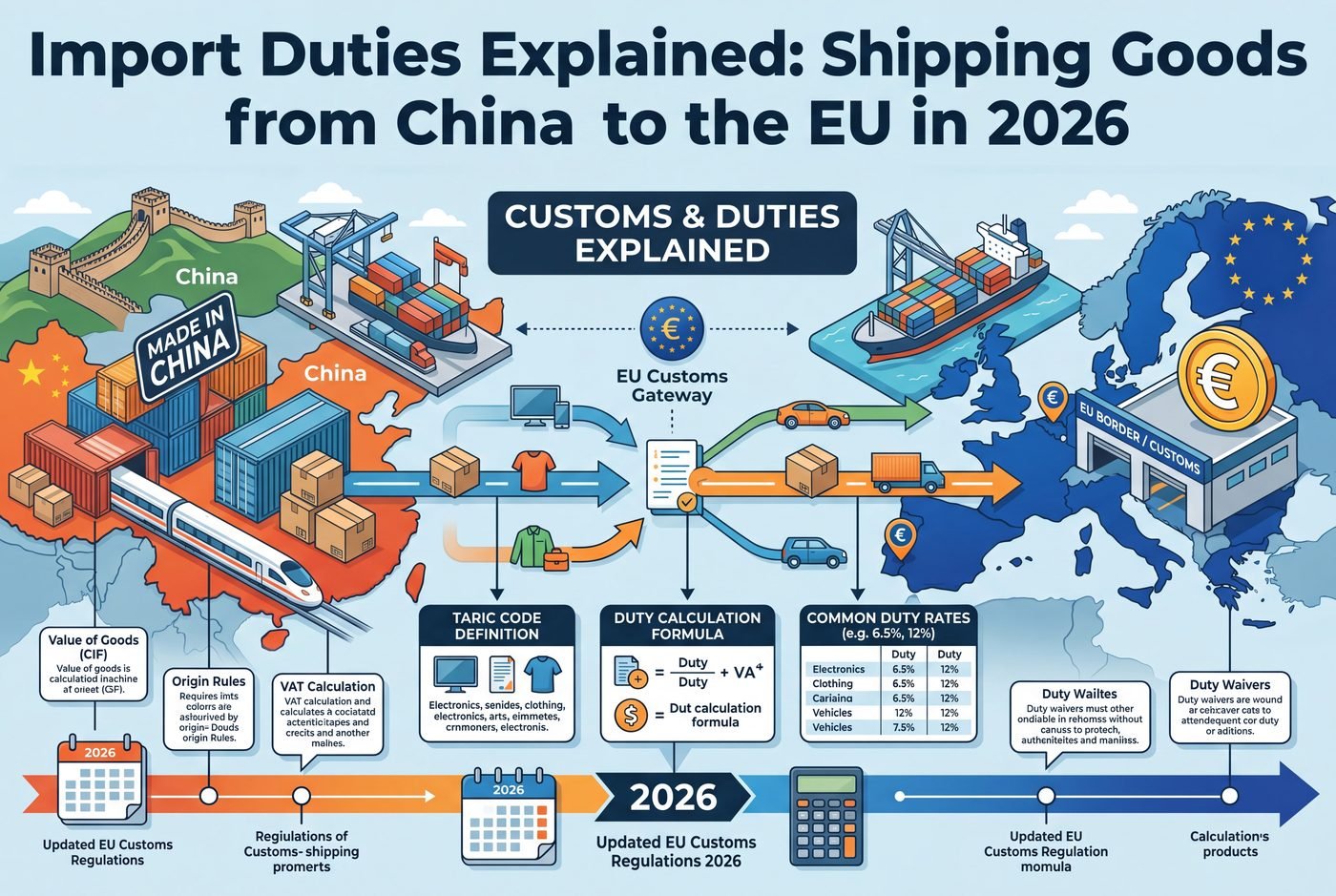
Every product imported into the EU is classified under a Harmonised System (HS) code — an internationally standardised 8-digit number that determines the applicable duty rate. The EU's customs tariff database (TARIC) lists the duty rate for every HS code and country of origin combination.
EU import duties for goods from China currently range from:
- 0% — certain raw materials, components, and goods with no EU equivalent
- 3–7% — most electronics, machinery, and industrial goods
- 12% — many consumer goods, clothing, footwear
- Up to 25%+ — sensitive categories including some agricultural products
Never rely on a supplier to tell you the duty rate. Always look it up yourself in TARIC using the correct HS code — misclassification is both a financial risk and a legal one.
Anti-Dumping and Additional Tariffs
Beyond standard customs duties, some product categories face additional anti-dumping or countervailing duties when imported from China. These can be substantial — in some cases exceeding 50% of the product value. Categories currently affected include certain steel products, solar panels, ceramic tiles, and bicycle parts.
Before sourcing any product from China, check TARIC for additional measures on your HS code. These are not always obvious from the product description alone.
Import VAT
Import VAT is charged at the EU border at the standard VAT rate of your country of import. In most EU member states this is 20–25%. The VAT is calculated on the customs value (FOB price + freight + insurance) plus the customs duty.
If you are VAT-registered in the EU, import VAT is fully reclaimable as input tax on your VAT return — so it is a cash flow item, not a real cost, for most businesses. For non-VAT-registered importers (small businesses below the threshold), import VAT is a real cost.
How to Calculate Landed Cost: A Worked Example
Suppose you're importing 1,000 units of a product from China with the following parameters:
- FOB price: €8,000
- Ocean freight (FCL, China to Rotterdam): €1,200
- Insurance: €50
- Customs duty rate: 6.5%
- Import VAT: 21% (Netherlands)
- Customs clearance: €180
- Inland delivery: €150
Customs value = FOB + freight + insurance = €9,250
Customs duty = €9,250 × 6.5% = €601
VAT base = customs value + duty = €9,851
Import VAT = €9,851 × 21% = €2,069 (reclaimable)
Total landed cost (ex. VAT) = €8,000 + €1,200 + €50 + €601 + €180 + €150 = €10,181
Per unit: €10.18 — versus a naive calculation of €8.00 per unit (FOB only). The difference matters enormously for margin planning.
Finding the Right HS Code
The HS code is the single most important piece of customs documentation for your shipment. Incorrect classification can result in:
- Underpayment of duty (a customs infringement with potential fines and back-payment)
- Overpayment of duty (you leave money on the table)
- Goods held at customs pending reclassification
To find the correct code, use the EU's TARIC database (ec.europa.eu/taxation_customs/dds2/taric) or consult a licensed customs broker. For new product categories, a binding tariff information (BTI) application gives you a legally binding classification from your national customs authority.
Practical Tips
- Always get your HS code confirmed before placing a large order, not after
- Ask your supplier for the HS code they use for export — it's a starting point, but the EU import classification may differ
- Consider entering goods via a low-duty EU port (some countries have more favourable handling) if your freight forwarder offers flexible routing
- Keep all import documentation (commercial invoices, packing lists, bills of lading) for at least 5 years — EU customs authorities can audit retrospectively
If you're unsure how to calculate the landed cost for a specific product, send us the details — we do this calculation as a standard part of every sourcing proposal.